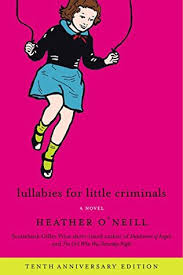
Now that I have finished reading Lullabies for Little Criminals by Heather O’Neill, I decided to look at one specific archetypal figure that I kept noticing while I was reading. This figure is the “Great Mother” figure, and it recurs throughout the novel.

Throughout the novel, Baby feels that she is incomplete, because she does not have a mother, as her biological mother died when she was very young (O’Neill 4). For the first twelve years of her life, Baby was raised by her father Jules, who was only fifteen years old when she was born (O’Neill 4). He does love her, but is not the best when it comes to taking care of her, often putting his own needs above Baby’s, especially when it comes to feeding his drug addiction (O’Neill 10).

However, Baby encounters multiple “Great Mother” figures throughout the course of the novel, although none of them are permanent. The first mother figure she meets is Isabelle, the foster mother of the group foster home Baby stays at while Jules is in the hospital being treated for tuberculosis (O’Neill 25). Isabelle seems to care for all of the children, and makes sure that they are well fed and properly taken care of. When the time comes for Baby to begin living with Jules again, Baby was hesitant to leave, stating “For a second, I wasn’t sure I wanted to her to let me go. Isabelle was very good about making me not worry about things. For instance, she would write the phone number of the foster home on the inside of my coat in case I got lost. The nights at Isabelle’s house were very quiet. I could really fall into a deep sleep because I knew I would be able to sleep until the morning.” (O’Neill 47). Baby felt a sense of stability living at Isabelle’s, because she was able to settle into a routine, and live in a consistently caring environment, which is a big step up from living with Jules. Jules is only twenty-six, and is a drug addict who lives a very inconsistent life (O’Neill 4).
Baby lives with Jules for a while, until he is sent to a rehabilitation centre after being caught by police with heroin (O’Neill 56). Baby’s social workers decide she can live with a neighbour named Mary, another motherly figure (O’Neill 58), who has two sons of her own, Felix and Joshua (O’Neill 59). Felix is the same age as Baby and they are in the same class at school, so they begin to form a bond similar to that of siblings (O’Neill 59). Mary treats Baby like her own child, and Baby begins to feel as if she belongs in this family. She says that “Mary and Felix were both so generous at heart that my being there didn’t seem out of the ordinary for them.” (O’Neill 63). However, all good things must come to an end, and as soon as Jules is out of rehab, he comes to get Baby and they move into a new apartment (O’Neill 88).
Baby lives with Jules again, until their relationship goes South, and she leaves to go live with a pimp named Alphonse (O’Neill 206). Baby beings to lose hope and feels that this is partially to blame on her lack of a mother. She feels like this until she reunites with Jules at the end of the novel, and they are on a bus driving to go meet his cousin Janine (O’Neill 319). During this bus ride, Baby asks Jules if her mother ever loved her (O’Neill 328). Jules replies with “Yes, my God! She loved you. She treated you like a doll. But if she would have lived, she would have loved you properly.” (O’Neill 328). That was the first time anyone had told Baby that she once had a mother who loved her (O’Neill 328), and this filled Baby with hope.

Once they get off of the bus, they meet Janine, who seems like she could be the next, and possibly most permanent, Great Mother figure in Baby’s life. The way Baby describes her first interaction with Janine sounds like she is describing the feeling of home, which is something she hasn’t felt a lot in her short life, “I could feel my heart beating when she hugged me against her, but now it felt fine. Then she held me in front of her, taking a good look at me. Her big blue eyes looked just like Jules’s, and I guess mine too. Her green winter jacket smelled like rain.” (O’Neill 330). This is the last line of the entire novel, and to me, it sounds like Baby has realized that it is okay for her to live without her biological mother, and that it doesn’t make her incomplete as a person. She seems to accept that many other people can be her mother, without having given birth to her.
I really enjoyed reading, as well as analyzing this novel, and I definitely recommend it. Let me know what you think in the comments below!
Works Cited
O’Neill, Heather. Lullabies for Little Criminals: A Novel. Harper Perennial, 2016.
 Emily's Blog