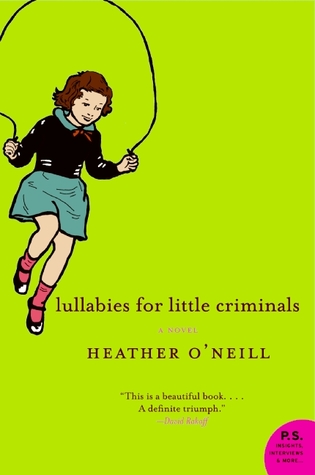
Since my last blog post about Heather O’Neill’s Lullabies for Little Criminals, a lot has happened. Before I get into my analysis, let me give you a quick summary.
Baby was living at a neighbour’s home while her father, Jules, was in rehab for his drug addiction. While staying at Mary’s with Mary’s children, Baby finds that she enjoys living in a loving environment, similar to her time at the foster home, where she felt like her foster mom really cared for her. Eventually, Jules finishes in rehab and is able to move back into an apartment with Baby. Baby quickly learns that Jules is a very different person after completing rehab. He is much colder, and seems disinterested in her wellbeing. Baby begins to hang out at a community centre, where she meets a kid named Theo, who doesn’t seem to fit in. Baby shares this with Theo and they quickly become friends, however, Theo is not a good influence on Baby. They break into the home of a girl that was bullying Baby and destroy many of her things. Theo is sent to a foster home shortly after, due to his mother having a breakdown.

Jules and Baby’s relationship isn’t doing too well either. Baby had recently started hanging around with a pimp named Alphonse, and Jules didn’t like this. They get into a massive fight which results in Baby going to juvie. This causes an even larger rift between Jules and Baby, and when Baby returns from juvie, she is not on good terms with Jules. Baby’s relationship with Alphonse quickly develops into a sexual relationship, which prompts Alphonse to “encourage” Baby to work as a prostitute, to make himself some more money. Around this time, Baby starts dating a boy named Xavier, who absolutely loves Baby.
The morning after an incident involving Alphonse hitting Xavier, Baby wakes up to find Alphonse dead next to her. She runs out of the apartment, leaving Alphonse behind, to the Mission down the street. Here she finds Jules, and he tells her that she is going to live with his cousin, outside of Montreal.

There are a couple common archetypal themes that I noticed while reading this novel. There is a lot of focus on how Baby feels that she is lacking a Great Mother figure, since her mother died when she was very young. I think that Baby meets three Great Mother figures throughout the book. The first is her foster mother, who was one of the first people, aside from Jules, to make Baby feel welcome and safe in an unfamiliar environment. The next, and most significant figure, is Mary, the neighbour that Baby stays with while Jules is in rehab. Mary treats Baby as if she is one of her own children, and Baby is sad to leave Mary’s home. She felt like she was a member of the family, and for once didn’t feel out of place. The third figure in Baby’s life is her father’s cousin Janine. We only meet Janine at the very end of the novel, but it is a very positive interaction that I think would continue to grow into something very good for Baby, if the story were to continue. Baby describes their hug in a way that makes it sound like she is being welcomed into a new family, “Then Janine stepped over to me and squeezed me hard. I could feel my heart beating when she hugged me against her, but now it felt fine. Then she held me in front of her, taking a good look at me. Her big blue eyes looked just like Jules’s, and I guess mine too.” (O’Neill 330)
“Mary and Felix were both so generous at heart that my being there didn’t seem out of the ordinary for them.” (O’Neill 63)
There are also a few symbols that stood out to me, as they were mentioned or referenced throughout the novel.
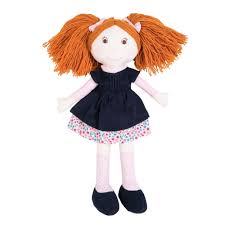
The first symbol that I noticed was dolls. Baby has a doll named Roxanne that was given to her by her mother. She loves this doll, and considers it to be one of her only prized possessions. I think that this doll represents her relationship with Jules. One day, Jules ripped Roxanne out of his frustration with Baby, but ended up sewing it back together. He ends up ripping the doll apart, around the same time their relationship begins to crumble. This crushes Baby, causing her to feel empty.
“Now I was a nothing, a real nobody.” (O’Neill 119)
At the end of the story, after Baby and Jules are reunited, Jules gives Baby a beautiful new doll. I think this symbolizes how they are about to start a new chapter in their lives, and start fresh.
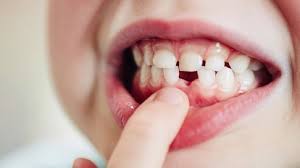
Another big symbol in Lullabies is Baby’s last baby tooth. She loses it while she is staying at Mary’s house. “I put my hand up to my mouth and spit out a tooth… It was my last baby tooth.” (O’Neill 64). I think that this tooth represents Baby’s innocence. Shortly after losing this tooth, Baby tries magic mushrooms for the first time. She later goes on to smoke weed, cigarettes, as well as become a prostitute after losing her virginity to Alphonse the pimp. Alphonse also allows her to try heroin for the first time, which was a huge moment in the book, as Jules is also a heroin addict.
This book is full of symbols and themes to explore, and I really enjoyed reading it. Let me know what you think in the comments!
Works Cited
O’Neill, Heather. Lullabies for Little Criminals: a Novel. Harper Perennial, 2016.



 Emily's Blog